
The Biology of Forgetting: It’s a Feature, not a Bug!

Here is the truth: Forgetting is not a failure. It is a biological necessity.
Your brain is constantly bombarded with sensory input—sights, sounds, conversations, and data. If it retained every single piece of information it encountered, your neural networks would be overwhelmed with noise.
To protect you, your brain filters aggressively. It asks two questions:
- Is this vital for my immediate survival?
- Have I used this information recently?
If the answer is "No," the brain initiates a "pruning" process. It deletes the data to free up space. This phenomenon was famously mapped out by Hermann Ebbinghaus.
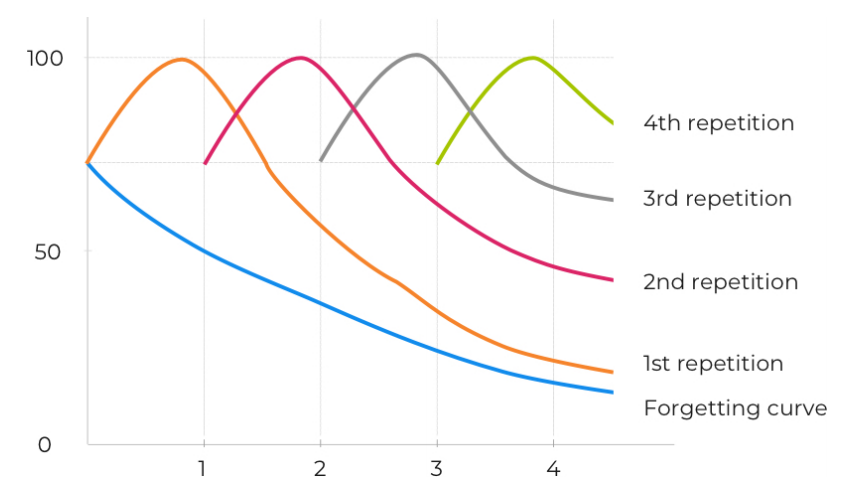
As the graph above illustrates, without intervention, you will forget roughly 50-70% of new information within 24 hours. This isn’t you being "bad at studying"—this is your brain doing its job.
The only way to stop this deletion process is to prove to your brain that this information is vital.
The Solution: Active Recall & Spaced Repetition
To hack your memory, you need to shift from passive input (reading, watching, highlighting) to active retrieval.
1. Active Recall: The "Mental Sweat"
Most students confuse familiarity with mastery.
- Passive Review: You read a page of notes. Your brain recognizes the text and says, "I know this." This is a lie. You recognize it, but you haven't encoded it.
- Active Recall: You look away from the notes and try to explain the concept from scratch. You struggle. You pause. You have to think hard.
That struggle is the point.
Memory is not built when you read the answer; it is built when you struggle to retrieve it. Every time you force your brain to pull information out of the archives, you physically strengthen the neural pathway.
This is the core philosophy behind Qbankly. We didn't build a question bank just to test you; we built it because answering questions is the most efficient form of Active Recall. When you face a Qbankly case study, you can't rely on passive recognition—you have to generate the answer. That "mental sweat" is where retention happens.
2. Spaced Repetition: Beating the Curve
If Active Recall is how you study, Spaced Repetition is when you study.
To reset the Forgetting Curve, you need to review information at specific intervals—right before your brain is about to delete it.
- Review 1: Immediate (or within 24 hours)
- Review 2: 3 days later
- Review 3: 1 week later
- Review 4: 1 month later
With every successful retrieval, the memory becomes more durable, and the gap between reviews can grow wider.
The 4-Step Protocol for "Sticky" Knowledge
Stop relying on brute force. Use this protocol to align your studying with your biology.
Step 1: Embrace the Struggle
Stop re-reading your textbooks. It feels comfortable, but it’s a waste of time. Instead, close the book and ask yourself: "How would I explain this mechanism to a 3rd-year student?" If you can't explain it simply, you don't know it.
Step 2: Use Qbankly as a Learning Tool, Not Just a Testing Tool
Don't wait until you feel "ready" to do practice questions. Start them early. Using Qbankly during your learning phase forces you into Active Recall immediately. It exposes your weak spots instantly (which is painful, but necessary) and prevents the "illusion of competence."
Step 3: Minimalist Resources
Cognitive overload destroys memory. If you use 5 different books and 3 video courses, your brain spends all its energy trying to integrate conflicting formats rather than storing the actual data.
- Pick 1 Primary Source (Textbook/Course)
- Pick 1 Active Source (Qbankly)
- Stick to them. Depth beats volume every time.
Step 4: Automate Your Review
You can't manage spaced repetition in your head. Use tools to help you. Whether it's a physical calendar or a digital tracker, ensure you are revisiting difficult topics before they fade completely.
Takeaways:
If you feel like you are working harder than everyone else but retaining less, stop fighting your biology.
You don't need a photographic memory. You don't need to study 14 hours a day. You just need to stop "reviewing" and start retrieving.
Your brain is a muscle. If you want it to grow, you have to lift heavy weights. Put down the highlighter, open a Qbankly session, and let the active recall process do the heavy lifting for you.